By Chris Hughes — CEO & Co-Founder, Sinder · Updated
Insights and explainers from the Sinder team on travel-card FX policies, UAE banking, and how to spend smarter abroad.
About the Sinder blog
The Sinder blog explains how travel-card FX really works for UAE residents — the FX charges bank cards publish abroad (the other cards reviewed on our comparison pages publish FX fees in roughly the 1.84%–3.14% range, with VAT and other charges additional), how the Mastercard Exchange Rate compares, and how to spend smarter in foreign currencies. Articles are written by the Sinder team and grounded in published issuer fee schedules.
Sinder vs Wio: The Real Cost of a Travel-Money Withdrawal Abroad — A real Wio ATM withdrawal in Thailand, funded from an AED account, cost a 21 AED ATM fee, a 67.79 AED (2%) FX transaction fee and a rate spread — about 3.4% all in. Here's the honest Sinder vs Wio fee
The Sinder App: A Smarter Way to Spend Abroad from the UAE — Discover how the Sinder app helps UAE travellers spend abroad from one AED balance with clearer FX, simpler travel payments, and better control over international card spending.
UAE Bank Cards Abroad: The 2–5% FX Leak and How Sinder Helps — Most UAE cards quietly skim 2–5% in FX markups every time you travel. See where the leak comes from—and how a zero FX card model like Sinder’s helps you keep more of your money.
How a 0% FX Economy Empowers Expats in Dubai and Beyond — Expats in Dubai quietly lose thousands to hidden FX fees. A 0% FX economy—powered by zero FX cards, multi-currency accounts and smarter fintech—can give that money back.
Join the Sinder Founder Series waitlist today to receive exclusive perks: https://sinder.ae/
Why now? October threads the climate needle: fairly clear in the north (Hanoi, Ha Long), warm along the central coast (Hue, Hoi An), and beach‑friendly in the south (Saigon, Mekong). Hanoi sees warm days and cooler evenings — great for street‑food strolls and lantern‑lit nights. Weather Spark+1
Ha Long
The vibe (what you’ll do): • Trek terraced hills (Sapa), then sail among Ha Long’s karsts • Ride the Reunification line or hop short flights south via Hue–Hoi An to Saigon • Finish with Mekong Delta markets or R&R on Phu Quoc
9‑day sample plan
Hanoi (3): Old Quarter food crawl, café culture, day cruise on Ha Long or Bai Tu Long.
Hue & Hoi An (3): Citadel history, imperial cuisine, beaches and tailor‑made threads.
Saigon (3): Cu Chi tunnels, War Remnants Museum, District 1 rooftops; Mekong day‑trip.
Budget (per person, per day)
Budget: ~AED 88
Mid‑range: ~AED 239
Luxe: ~AED 668 (Based on BudgetYourTrip national averages of $24 / $65 / $182.) Budget Your Trip
Where to stay — Telegraph picks Telegraph Travel highlights nationwide standouts and city favorites, including:
Hanoi: Sofitel Legend Metropole; InterContinental Westlake; Apricot Hotel; Hotel de l’Opera; Silk Path Boutique. Telegraph
Saigon: The Reverie Saigon; Park Hyatt Saigon; Hôtel des Arts Saigon; Le Méridien Saigon; Villa Song Saigon. Telegraph
Coast/resorts: Four Seasons Resort The Nam Hai (Hoi An); Zannier Hotels Bãi San Hô (Phú Yên). Telegraph
Getting there from the UAE
DXB ⇄ Hanoi: round‑trip fares recently from ~$399 (~AED 1,465); Emirates currently shows 7 flights/week on the route (schedule dependent). Skyscanner+1
Sinder tip Markets, tailors and street eats add up — pay in VND with 0% FX so your phở and lanterns stay excellent and inexpensive.
Visa note (many nationalities incl. UAE residents): Vietnam’s official e‑visa allows single or multiple entry for up to 90 days; apply online at the government portal. eVisa Vietnam+1
Join the Sinder Founder Series waitlist today to receive exclusive perks: https://sinder.ae/
By Sinder · Mon, 27 Oct 2025 10:08:05 GMT · 1 min read
Yalla, Go! Southwest China in October (Guangxi & Yunnan)
*The Great Wall is not included in this itinerary.
Join the Sinder Founder Series waitlist today to receive exclusive perks: https://sinder.ae/
Why now? October is the golden window: warm, drier days and clear air for karst‑country cruising on the Li River, cycling around Yangshuo, and high‑altitude hiking between Lijiang and Shangri‑La. Expect comfortable days (about 22–28°C in Guilin) and cooler evenings. Weather Spark+1
Li River
Watch the calendar: China’s National Day “Golden Week” runs October 1–7 — countrywide travel is busy. Go just after for calmer trains, hotels and sights. China Briefing+1
Lijiang
The vibe (what you’ll do): • Drift past limestone peaks on a Li River boat (Guilin → Yangshuo), then bamboo‑raft a quiet tributary • Walk Lijiang’s cobbled alleys and toast sunset on Black Dragon Pool • Hike Tiger Leaping Gorge — one of Asia’s classic trails — best Sept–Oct for crisp, dry views China Discovery+1
10‑day sample plan
Guilin & Yangshuo (4 days): River cruise, Xingping old town, rice‑terrace day trip.
Shangri‑La / Zhongdian (3 days): Ganden Sumtseling Monastery & alpine meadows; optional day hike along Tiger Leaping Gorge if you didn’t tackle the full route earlier.
Budget (per person, per day)
Budget: ~AED 125
Mid‑range: ~AED 308
Luxe: ~AED 752 (Based on Guilin averages of $34 / $84 / $205; conversion ~3.67 AED/USD.) Budget Your Trip
Where to stay — Telegraph coverage Telegraph Travel’s China reporting has highlighted notable stays in this region, including:
Club Med Guilin — a resort base amid karst scenery. Telegraph (Telegraph’s broader “Best hotels in China” list is paywalled but provides further context.) Telegraph
Banyan Tree Ringha
Getting there from the UAE
DXB ⇄ Kunming (gateway to Yunnan): recent returns from ~AED 1,269, with occasional nonstop ~6h15m flights appearing on schedules. Skyscanner+1
Climate check (Guilin, Oct): highs around 23–28°C, cooler nights — ideal for outdoor time. Weather Spark+1
Sinder tip Rural cafés and guesthouses prefer local cards or cash — pay in CNY with 0% FX and skip surprise conversion fees.
Visa note (UAE residents/citizens): Tourist L‑visas are required; apply via the Chinese Visa Application Service Center (Dubai). Visa for China+1
Join the Sinder Founder Series waitlist today to receive exclusive perks: https://sinder.ae/
By Sinder · Mon, 27 Oct 2025 09:54:48 GMT · 1 min read
Yalla, Go! New York City in October (from the UAE)
Join the Sinder Founder Series waitlist today to receive exclusive perks: https://sinder.ae/
Why now? Autumn turns the city crisp and walkable. Maple reds arrive in Central Park, museum shows roll out, and rooftop sunsets hit just right. If you’re timing a trip for a special weekend, Open House New York throws open 300+ normally closed doors citywide each October — architectural icons, hidden gardens, studios, even infrastructure sites. It’s an eye‑opening way to see NYC from the inside. Open House New York
Typical temps: ~10–18°C through October; pack layers and a compact umbrella. Holiday Weather
The vibe (what you’ll do): • Leaf‑peep and picnic in Central Park, Fort Tryon Park or Staten Island’s Greenbelt • Gallery‑hop (Chelsea, Tribeca, the LES) and catch a Broadway matinee • Ferry to Brooklyn for markets, pizza pilgrimages, and skyline rooftops • Day‑trip options: Hoboken by 8‑minute Hudson ferry; Montauk for seaside; Niagara Falls by rail or flight
A 5‑day sample plan
Day 1–2: Midtown icons (Top of the Rock, Fifth Ave) + Central Park color walk; evening on a rooftop in NoMad or Williamsburg.
Day 3: Museums (The Met or MoMA) + Upper East Side to East River tram to Roosevelt Island.
Day 4: Downtown loop — SoHo → Greenwich Village → the High Line → sunset at Pier 57.
Day 5: Choose your adventure: Harlem food tour, DUMBO photo walk, or a Hudson Valley foliage escape.
Budget (per person, per day)
Budget: ~AED 480
Mid‑range: ~AED 1,332
Luxe: ~AED 4,041 (From BudgetYourTrip averages of $131 / $363 / $1,101; converted at ~3.67 AED/USD.) Budget Your Trip
Where to stay — Telegraph picks Telegraph Travel’s NYC short‑list includes icons and buzzy newcomers:
The St. Regis New York (Midtown glamour)
The Benjamin (suite‑style rooms, Midtown East)
The Pierre, A Taj Hotel (Uptown grande dame on Central Park)
The Carlyle (Upper East Side classic with Bemelmans Bar)
The Fifth Avenue Hotel (NoMad show‑stopper) Telegraph
Read individual Telegraph reviews: The Pierre, The Carlyle, The Fifth Avenue Hotel.
DXB ⇄ NYC (JFK/EWR): recent return fares from ~AED 1,784 on one‑stop itineraries; nonstop options on Emirates (to JFK) and United (to EWR). Flight time ~13h55–15h25. Skyscanner+2FlightsFrom+2
Sinder tip Tap and pay in local currency with 0% FX so your bagels, Broadway and boutique buys cost what the sticker says.
Join the Sinder Founder Series waitlist today to receive exclusive perks: https://sinder.ae/
By Sinder · Mon, 27 Oct 2025 06:46:24 GMT · 1 min read
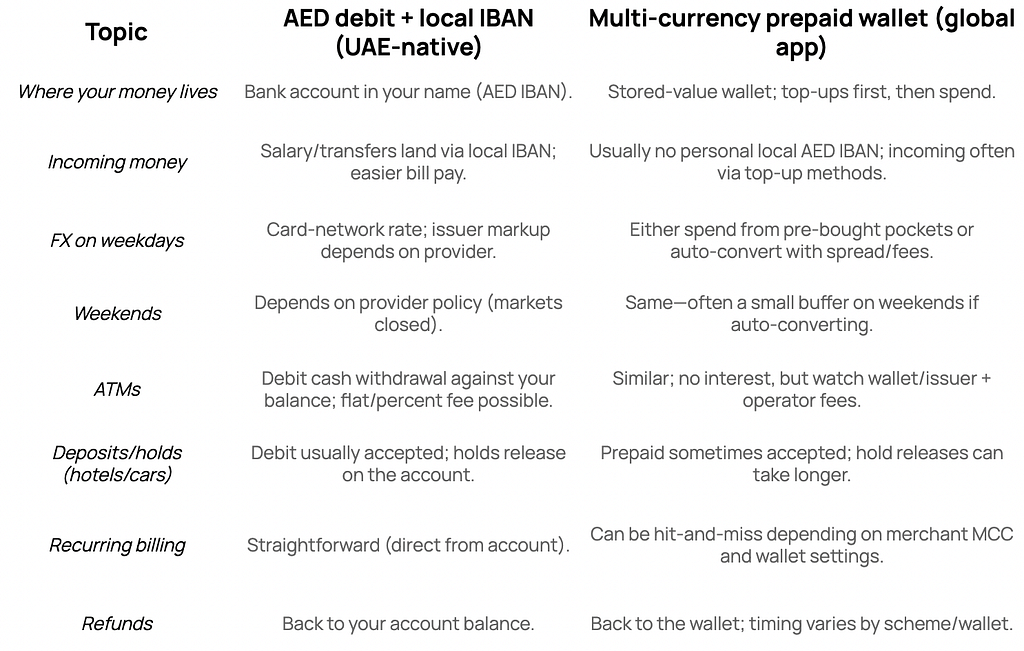
AED debit + local IBAN vs multi-currency prepaid: what actually changes when you travel?
AED Debit + Local IBAN vs Multi-Currency Prepaid — UAE Traveller’s Guide
Two popular “card” models behave very differently abroad. Here’s how an AED debit with a local IBAN compares to a multi-currency prepaid wallet — for FX, ATMs, refunds, deposits, and billing.
TL;DR
An AED debit account with a local IBAN and a multi-currency prepaid wallet can look similar in an app, but they’re not. They differ on how money is held and moved, FX handling, ATM rules, merchant acceptance (deposits/recurring), and refund timing. These differences are what you actually feel on a trip.
The quick comparison
Why FX behaviour matters more than the headline
Issuer markup vs network fees: “0% FX” usually refers to issuer markup. Card-network fees may still apply.
Pre-buying pockets: With multi-currency wallets, you may need to pre-purchase USD/EUR/GBP to avoid auto-conversion spreads — handy for budgeting, but extra steps.
Weekends: Wholesale FX is shut; some providers add a small weekend buffer. Always check the published policy.
UAE-first principle: keep it simple — no issuer FX markup on weekdays (network/scheme fees may apply), and publish the weekend policy in plain English.
ATMs, DCC, and those “mystery” fees
ATMs: prefer major-bank ATMs; expect potential operator fees in some countries.
DCC: when a POS/ATM offers to charge you in AED abroad, decline. Pay in the local currency for a cleaner rate.
Refunds & reversals: debit typically sees faster, cleaner reversals to the account than wallets relying on top-up rails.
Who should choose what?
Everyday UAE banking + travel: AED debit with local IBAN keeps salary/bills/recurring simple and travel clean.
Strict trip budgets / pocketing: multi-currency prepaid can be useful if you like pre-allocating travel money by currency, accepting the conversion step.
Takeaways
The plumbing (IBAN vs wallet) dictates real-world UX.
Focus on: weekday FX, weekend policy, ATM rules, and DCC avoidance.
Pick the model that fits how you actually live and travel.
Disclosure: Information here is general and may change. Always check the latest tariff before you travel.
By Sinder · Sat, 13 Sep 2025 07:26:55 GMT · 1 min read
The real cost of “zero-FX” or “low fee” cards in the UAE (2025): a data-driven comparison
We modelled a like-for-like scenario across popular UAE cards and our own tiers to answer a simple question:
What would you actually pay on USD 10,000 of weekday foreign spend — and on USD 10,000 equivalent of international ATM withdrawals? (Totals below are in AED; weekend adjustments, ATM operator surcharges, and promo waivers excluded.)
TL;DR (weekday pricing)
POS (USD 10k spend):
Sinder (Founder) AED 0.00 • 0.00%
Sinder (Premium) AED 25.00 • 0.07%
Sinder (Standard) AED 435.25 • 1.19%
Wio Personal AED 783.00 • 2.13%
Emirates NBD GlobalCash AED 1,072.28 • 2.92%
Al Ansari TravelCard AED 1,151.00 • 3.14%
FAB Travel Card (Credit) AED 1,589.33 • 4.33%
ADCB Traveller (Credit) AED 1,867.16 • 5.09%
International ATM (USD 10k equivalent cash):
Sinder (Founder) AED 367.00 • 1.00%
Sinder (Premium) AED 392.00 • 1.07%
Sinder (Standard) AED 702.25 • 1.91%
Wio Personal AED 1,093.00 • 2.98%
Emirates NBD GlobalCash AED 1,172.28 • 3.19%
Al Ansari TravelCard AED 1,301.00 • 3.54%
FAB Travel Card (Credit) AED 2,635.28 • 7.18%
ADCB Traveller (Credit) AED 3,023.21 • 8.24%
Why such big gaps? Multi-currency wallets often require pre-purchasing specific currencies or charge for wallet swaps and fallbacks. Credit cards treat ATM withdrawals as cash advances (extra fees + interest). Plan/issuance fees also add up.
What we measured (quick methodology)
Scenarios: (1) USD 10,000 of weekday foreign POS spend; (2) USD 10,000 equivalent of international ATM withdrawals.
Included: Plan/subscription and issuance costs where applicable; wallet conversion/swap costs; FX markups; cash-advance/ATM fees and other card-published line items.
Excluded: Weekend FX adjustments, third-party ATM operator surcharges, and temporary promotional waivers.
Data vintage: Model reflects fee schedules used as of 5 September 2025. Always check the latest tariff before deciding.
Notable UX & “gotchas” (by product type)
Multi-currency wallets (prepaid/debit): need pre-funding into specific purses (USD/EUR/GBP etc.). Spending outside a preloaded purse can trigger fallback FX and/or wallet-swap fees. Watch for inactivity, reload, and unload/closure fees.
“No-FX” travel credit cards: “No FX fee” usually means no bank markup; you still convert at the network rate. Cash withdrawals are cash advances (flat fees, higher interest), and annual fees can dominate.
Sinder tiers: simple weekday pricing at card-network rates on eligible tiers for POS, plus a straightforward 1% international ATM fee in our model. Fair-use limits and allowances apply; see pricing at launch.
How to choose (practical guidance)
Mostly card POS on trips? A low-markup debit option with simple allowances tends to have the lowest total cost.
Need frequent cash abroad? Avoid using credit cards as your main cash source; cash-advance mechanics are expensive.
Prefer multi-currency wallets? Confirm your destination currencies are supported and check swap/fallback rules before you fly.
Scan the tariff, not just the headline. Plan/issuance fees, wallet-swap rules, cash-advance terms, and inactivity charges matter.
Assumptions & disclaimers (please read)
This article is educational and based on our internal model of card-published fees as of 5 Sep 2025. Providers change pricing; please verify the latest terms.
Results use weekday pricing; weekend adjustments (if any) vary by provider and aren’t included here.
ATM operator surcharges are not included and may apply.
Some compared products are credit cards with eligibility/risk criteria different from debit or prepaid.
Our card & partners: The Sinder card will be issued by a licensed partner bank. Features, pricing, allowances, and fees may change and remain subject to partner and regulatory approval. We don’t use partner names or marks here and make no claims on their behalf.
Final word
Transparent FX is about the total you actually pay, not just a headline. In our modelled weekday scenario, Sinder’s simple structure leads on both POS and ATM. If you’d like early access when we open the doors, join the waitlist — then focus on the fun part of your trip.
By Sinder · Fri, 05 Sep 2025 09:41:55 GMT · 2 min read
The 72-Hour Maldives Escape: A Luxe-to-Mid-Range Guide for Dubai Weekend Warriors
Four hours in the air is all that separates the skyscrapers of Dubai from sugar-white sandbanks, gin-clear lagoons and postcard sunsets. If you have a long weekend to spare, here’s everything you need to turn the Maldives into an effortless 3-day dose of barefoot luxury (or smart mid-range value).
Quick-Look Travel Facts
Flight time: 4 h 05–4 h 15 min nonstop (Emirates or flydubai)
Time difference: UTC + 5 (one hour ahead of Dubai)
Best time to visit: Dry season November — April for blue skies; May — October brings brief tropical showers but bigger savings
Getting There from Dubai
Daily morning and evening departures mean you can clock out of work, catch a late flight, and wake up in paradise. Economy returns hover around AED 1,500–2,500 if you book a couple of months ahead, with mid-week departures the cheapest.
Transfers: Speedboat or Seaplane?
Shared speedboat
Cost: about US $100 round-trip (e.g., Kurumba)
Travel time: 10–30 min to North/South Malé atolls
Why pick it? Perfect for short stays — no waiting around, you’re on the beach fast.
Shared seaplane
Cost: roughly US $300–700 round-trip (resort-dependent)
Travel time: 35–55 min plus lounge time
Why pick it? Epic aerial views and access to more remote, quieter atolls.
Pro tip: If every minute counts, choose a resort within speedboat reach of Malé.
Why you’ll love it: Space-to-guest ratio is off the charts and service is flawless
A 3-Day “Taste of Paradise” Itinerary
Day 1 — Arrival & Unwind
Land in Malé around 09:30, speedboat to resort, check-in
Beach time + reef snorkel
Champagne sunset cruise followed by a Maldivian drum show
Day 2 — Adventure & Indulgence
Dawn dolphin-watch cruise or reef dive
Spa session and infinity-pool lazing
Dinner at an underwater restaurant (or your resort’s fine-dining equivalent)
Day 3 — Local Colour & Departure
Morning sandbank picnic and paddle-boarding
Quick hop to Malé for souvenir shopping and a peek at the Grand Friday Mosque
Late-afternoon flight back to Dubai
What It Really Costs (per person, sharing a room)
Mid-Range Weekend (Kurumba example)
Flights: US $490
Transfers: US $100 (speedboat)
Accommodation: US $1,050 (three nights)
Meals & activities: US $400 ≈ US $1,650 total (≈ AED 6,100)
Luxury Weekend (Reethi Rah example)
Flights: US $680
Transfers: US $600 (seaplane/yacht)
Accommodation: US $7,500 (three nights)
Meals & activities: US $1,200 ≈ US $10,000+ total (≈ AED 37,000)
Figures include service charges and GST where applicable; always double-check your invoice for extras.
Practical Tips & Tricks
Pack reef-safe sunscreen — traditional formulas damage coral.
Dress modestly when transiting Malé or visiting local islands; swimwear is fine on resort islands.
Pre-book activities in high season (December to April) to avoid wait-lists.
Travel light: Seaplanes cap luggage at 20 kg; excess fees are steep.
Shoulder months (November and April) give you clear skies without peak-season rates.
Sustainability & Etiquette
Choose resorts with marine-biology programs or coral-adoption schemes — your snorkel fees can help rebuild reefs.
Skip single-use plastics; most resorts supply refillable glass bottles.
Remember the Maldives is predominantly Muslim: no alcohol in Malé city, and no topless sunbathing anywhere.
Final Thoughts
Whether you’re chasing value-packed convenience at Kurumba or going all-out glam at One&Only Reethi Rah, the Maldives is shockingly doable for a Dubai long weekend. With direct four-hour flights, hassle-free visas and the sort of beaches most destinations can only Photoshop, your next 72-hour escape is a boarding pass away. See you on the sand! 🏝️✈️
By Sinder · Sun, 08 Jun 2025 08:03:05 GMT · 2 min read
Outbound Travel Trends for UAE Residents (2022–2024)
Introduction: UAE residents have enthusiastically resumed personal and leisure travel in the post-pandemic period, with outbound trips surging since 2022. International departures from the UAE jumped by 51% in 2023 as pent-up demand and eased restrictions enabled more travel (Top ten outbound destinations from the UAE — Hotel Management Network). Unlike some markets dominated by a single destination, UAE travelers are spread across many countries — five of the top ten outbound destinations are within the Middle East, alongside popular long-haul spots (Top ten outbound destinations from the UAE — Hotel Management Network). This report examines two key segments — white-collar professionals and the broader population — and analyzes how their favorite destinations and travel habits differ. It also highlights seasonal patterns, noting how summer escapes, winter holidays, and special breaks (Eid, school vacations) influence where UAE residents go. Where possible, distinctions in preferences by demographics (Emiratis vs. expats, families vs. singles, etc.) are noted.
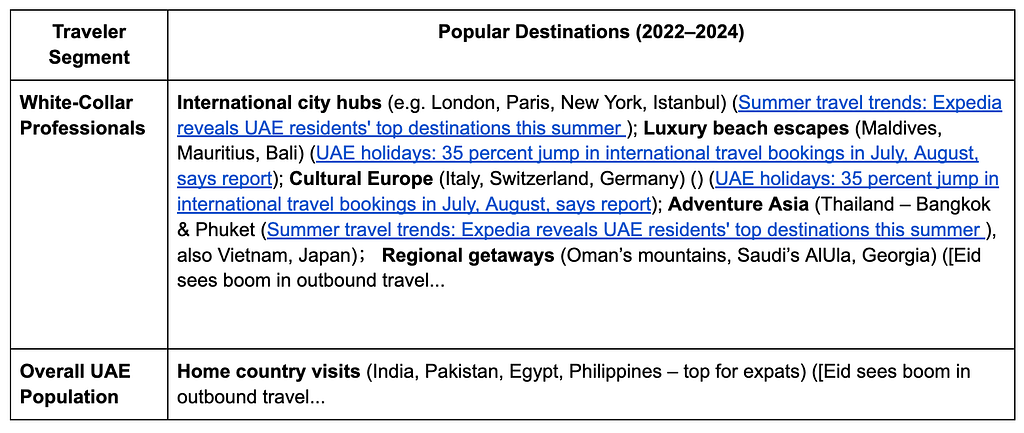
White-Collar Professionals: Travel Preferences and Destinations
High Travel Frequency and Budgets: White-collar professionals in the UAE (including many mid-to-high income expats and Emirati nationals) tend to travel frequently and spend generously on leisure trips. Surveys indicate that 72% of UAE residents planned to spend more on travel in 2023, with travel budgets up ~8% from the year prior (Travelers from UAE traveling more and spending more on trips) (Travelers from UAE traveling more and spending more on trips). Many professionals take multiple holidays annually — for example, Emirati citizens travel an average of three times per year, often favoring trips that offer luxury and comfort (Emiratis prefer luxury travel | Ours Abroad News). Affluent travelers form a significant segment of the UAE market: 25% of UAE respondents in a global survey identified as “luxury travelers,” one of the highest proportions worldwide (). These travelers show a strong preference for long-haul destinations in Europe and beyond. In fact, Europe is a top choice — UAE and Saudi tourists are projected to spend heavily in European destinations, with favorites including the UK, Germany, Italy, and Switzerland, alongside the US and popular Asia-Pacific locales (). This reflects a taste for diverse experiences and premium travel among the professional class.
Top Destinations for Professionals: The preferred leisure destinations of white-collar workers skew toward international city trips and upscale getaways, as evidenced by booking and search data from 2023–2024. According to Expedia’s UAE Summer Travel Outlook, major global cities dominated summer plans — London, Istanbul, Paris, Bangkok, and New York ranked as the top five destinations for UAE residents in summer 2024 (Summer travel trends: Expedia reveals UAE residents’ top destinations this summer ). These cities offer cultural attractions, shopping, and cooler climates that appeal to professionals looking for an urban escape. European travel in particular saw huge demand: visa service data shows Europe accounted for 65% of travel inquiries from UAE clients in Q2 2024 (a 20% year-on-year rise) (European Destinations Dominate Summer Travel Preferences for UAE Residents). The UK (especially London) remains a perennial favorite, and interest in Mediterranean countries (e.g. Greece, Italy, Spain) has surged for their mix of culture and summer events (European Destinations Dominate Summer Travel Preferences for UAE Residents). Professionals are also drawn to Asian hubs and islands — Thailand has been extremely popular, with Bangkok and Phuket in high demand for their blend of affordability and attractions (Summer travel trends: Expedia reveals UAE residents’ top destinations this summer ) (Summer travel trends: Expedia reveals UAE residents’ top destinations this summer ). Beach luxury destinations are another staple: travel agency data for mid-2024 shows Thailand, the Maldives, and Mauritius among the most-booked holiday spots, alongside Turkey and the UK (UAE holidays: 35 percent jump in international travel bookings in July, August, says report). These choices indicate that many working professionals seek resort stays and tropical beaches (Maldives, Mauritius, Thailand’s islands) as well as vibrant city experiences (London, Istanbul) during their vacations.
Travel Style and Motivations: Flexibility in work arrangements has given rise to new travel habits among professionals. A notable trend is the “workcation” or work+holiday concept: UAE’s leading OTA musafir.com observed many professionals opting to work remotely from cooler destinations abroad during the summer (musafir.com Unveils August Travel Trends: UAE Residents Embrace Diverse Vacation Styles | UAE News 24/7). This allows them to escape the UAE heat without fully disconnecting from jobs. Longer itineraries are also in vogue — in peak summer, many travelers (often families) favor trips around 15 days or more to maximize the break (musafir.com Unveils August Travel Trends: UAE Residents Embrace Diverse Vacation Styles | UAE News 24/7). However, white-collar workers without school-age kids often take additional shorter trips throughout the year, capitalizing on long weekends or Eid breaks. They also tend to plan ahead; over half of UAE travelers reported booking well in advance to lock in deals or avoid price hikes (Travelers from UAE traveling more and spending more on trips).
Demographic Patterns (Professionals): Within this segment, preferences can vary:
Expat Professionals (Western vs. Asian): Western expats (e.g. British, European, North American) frequently fly back to their home countries or nearby Europe for vacations. For instance, the UK and USA consistently rank among top outbound destinations due to the large British and American expat community (Eid sees boom in outbound travel… | Connecting Travel). These travelers also leverage the UAE’s geographic hub location to explore the region — short-haul leisure trips to Turkey, Georgia, Oman, or Egypt are popular for long weekends (Eid sees boom in outbound travel… | Connecting Travel). Asian expat professionals (Indian, Pakistani, Filipino, etc.) often devote at least one major holiday to visiting family back home, contributing to destinations like India, Pakistan, and the Philippines being among the most-booked in peak travel periods (Eid sees boom in outbound travel… | Connecting Travel). However, many also take additional leisure trips elsewhere; for example, Thailand, Malaysia, and Indonesia have grown in popularity as getaway spots for South Asian expats when they are not on home visits (Trending destinations for Middle East travellers; see list). Notably, India and Egypt consistently appear in the top outbound rankings largely due to VFR (visiting friends/relatives) traffic from the UAE’s huge Indian and Arab expat populations (Trending destinations for Middle East travellers; see list) (Wego reveals most popular winter travel destinations for GCC travelers | Wego Company).
Demographic Distinctions: In the broader population, travel preferences often correlate with the traveler’s origin and family status:
Emirati Nationals: The UAE’s citizens, though only ~11% of the population, are an influential segment of outbound travel. They tend to travel frequently (often multiple trips per year) and in large family groups. Emiratis have a strong affinity for luxury travel experiences — they commonly choose high-end resorts and long first-class flights, supported by one survey noting an increase in spending on vacations among citizens (Emiratis prefer luxury travel | Ours Abroad News). At the same time, many Emirati families travel for cultural enrichment and education. Europe remains highly popular (London is sometimes jokingly called “the UAE’s summer district” given the influx each year), and Emiratis also explore the U.S. and East Asia for new experiences. There’s growing interest in destinations like Japan and South Korea among young Emiratis seeking novel culture, as well as African safaris for those who have been everywhere else. Nonetheless, GCC countries are easy options for quick trips (short flights and cultural familiarity), and Oman or Saudi mountain resorts are favored for short summer retreats (musafir.com Unveils August Travel Trends: UAE Residents Embrace Diverse Vacation Styles | UAE News 24/7). In terms of timing, Emiratis often capitalize on school vacations for extended trips, but being locals, they can also take short-notice breaks over long weekends.
South Asian Expats: By sheer numbers, Indians (the largest expat group) and other South Asians shape UAE travel trends. These communities allocate much of their travel to home visits, especially during school holidays (e.g. an Indian family in Dubai might send children to stay with grandparents in India each summer). This VFR flow is why India perennially tops outbound passenger traffic from UAE airports (Eid sees boom in outbound travel… | Connecting Travel). Aside from home trips, South Asian expats are price-conscious and often seek value destinations for leisure — places like Azerbaijan, Georgia, Turkey, or Malaysia that offer affordable visas and tours are popular. Many also enjoy group tours to Europe or East Asia on special occasions. Religious trips such as to Makkah for Muslim expats or to religious sites in India (for Hindus and others) also contribute to travel numbers.
Western Expats: Westerners in the UAE (from Europe, North America, Oceania) typically have high disposable incomes and generous leave, but often split their travel between exploring new regions and returning home. Thus, the UK, USA, Canada, Australia see a lot of traffic from this group (e.g. flights to London and New York are busy during Christmas as expats fly back). When touring, Western expats frequently leverage the UAE’s location to visit bucket-list destinations in Asia or Africa that are closer than from their home country — for instance, a British professional in Dubai might spend Eid in Sri Lanka or Kenya, or take a short hop to Petra in Jordan. They are also active in the local travel scene, taking weekend trips to places like Jordan, Oman, or the UAE’s northern emirates for hiking and camping.
Families vs. Solo Travelers: Family travelers (across all nationalities) plan around school breaks and tend toward safe, convenient destinations. Surveys show UAE family and couple travel groups made up 80% of international trips in recent data (Emiratis prefer luxury travel | Ours Abroad News). They often prefer long summer vacations in one country (e.g. a month in the UK or in Kerala, India), or theme park-centric trips (Orlando, Paris for Disneyland). Singles and young adults from the UAE, on the other hand, have shown increasing interest in solo travel and unique experiences. In a 2023 Hilton study, 85% of UAE respondents said they seek new places they’ve never been and many embrace spontaneity (New Data Reveals the Approach of Evolving UAE Traveller ‑ Stories From Hilton ‑ EMEA) (New Data Reveals the Approach of Evolving UAE Traveller ‑ Stories From Hilton ‑ EMEA). This has led to a rise in UAE-based travelers going on solo backpacking trips or joining adventure tours in places like Nepal, Vietnam, or South America. The solo trend is backed by the finding that 61% of UAE travelers were considering a solo trip in the near future for personal enjoyment (New Data Reveals the Approach of Evolving UAE Traveller ‑ Stories From Hilton ‑ EMEA). Clearly, the broader population’s travel profile is far from monolithic — it ranges from large family reunions abroad to intrepid solo treks — making the UAE a significant source market for a wide array of global destinations.
Seasonal Travel Trends: Summer Getaways, Winter Holidays, and Festive Breaks
UAE residents’ destination preferences shift with the seasons, largely driven by the desert climate (very hot summers, mild winters) and the academic/work calendar. Below we break down how travel patterns differ in summer vs. winter vs. holiday periods like Eid and school breaks:
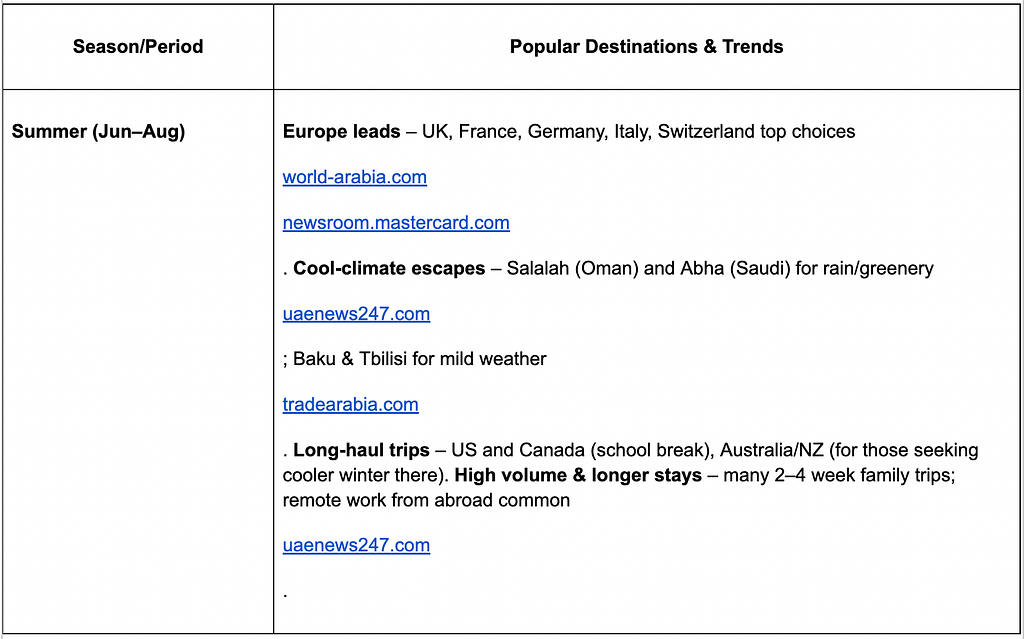
Summer Escapes (June–August): Summer is peak outbound travel season as residents flee the extreme heat (40°C+) and schools close for ~2 months. This period sees the largest volume of travel and a distinct skew toward cooler climates. Europe dominates summer choices for UAE travelers. In 2023–24, travel agencies reported Europe accounting for a majority of bookings: for example, dnata Travel noted Thailand, the Maldives and Mauritius as top choices but also listed the UK and Turkey in the summer top five (UAE holidays: 35 percent jump in international travel bookings in July, August, says report), and Europe as a whole saw unprecedented demand. According to The Visa Services in Dubai, Europe comprised 65% of all travel visa requests in Q2 2024 (up 20% from the prior year) (European Destinations Dominate Summer Travel Preferences for UAE Residents). Popular European countries included Spain, Greece, Germany, Italy, France, Portugal, and Switzerland (European Destinations Dominate Summer Travel Preferences for UAE Residents), aligning with major events and cooler weather there. Many Emirati and expat families spend part of the summer in London or Paris, then hop across multiple European destinations. In 2024, London remained the top hotspot, with searches up 35%, and interest in Athens (+54%) and Rome (+16%) also rising as people sought out cultural festivals and sports events (e.g. the UEFA football championship in Germany) (Summer travel trends: Expedia reveals UAE residents’ top destinations this summer ) (Summer travel trends: Expedia reveals UAE residents’ top destinations this summer ).
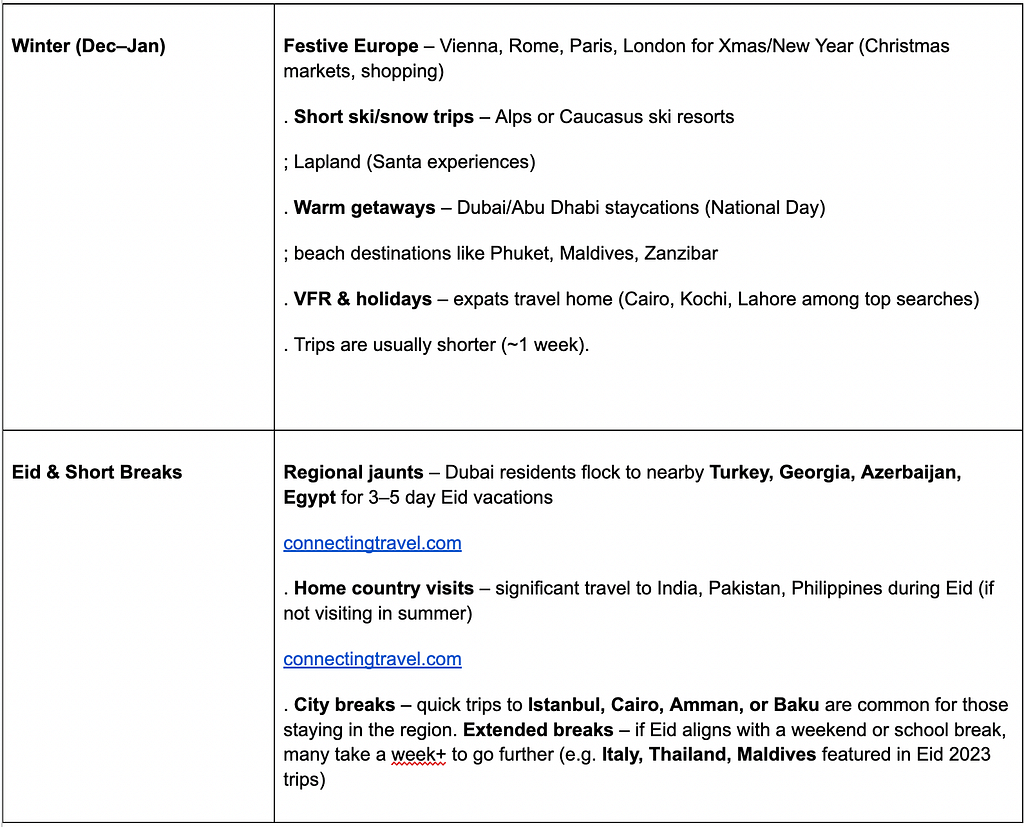
Winter Holidays (December–January): Winter in the UAE is pleasantly mild, so residents don’t need to escape climate-wise — yet many still travel during the end-of-year holiday season, particularly around Christmas/New Year and the UAE’s National Day break (early December). Winter travel is shorter in duration (often 1–2 weeks or just long weekends), but destinations reflect two main motives: seeking winter festivities vs. seeking warmth (for those who actually feel chilly in UAE’s 20°C weather!). On the festive side, European cities shine in winter. Demand spikes for places with Christmas markets, New Year celebrations, or snow. In late 2023, Vienna and Rome topped the list of trending winter destinations, as UAE travelers showed huge interest in European Christmas markets ( ) ( ). Amsterdam also emerged as a favorite, with searches up 65% for Dec–Jan trips ( ) ( ). Furthermore, Paris and London saw massive year-on-year growth in interest (+235% and +205%, respectively) as many residents planned holiday shopping or to enjoy the festive atmosphere in those cities ( ). An interesting niche trend is travel to the far north for unique winter experiences — for example, trips to Rovaniemi in Finnish Lapland (Santa Claus’ hometown) became popular among families seeking a “Santa in the snow” experience ( ) ( ). Closer to the region, ski vacations have caught on as well; nearby alpine resorts in the Caucasus, like Shahdag (Azerbaijan) and Gudauri (Georgia), have drawn UAE winter tourists for a short ski break ( ).
For those who don’t crave snowflakes or family gatherings, warm-weather getaways are the winter antidote. Many residents take advantage of the shorter breaks to visit beach destinations that are in their prime season during Dec–Feb. For example, Zanzibar, Phuket, and Singapore were highlighted as attractive options for escaping “winter chill” in late 2023 ( ). These offer tropical climate, resorts, and a change of scenery when UAE’s winter, while mild, doesn’t have tropical greenery. Other popular warm winter trips include the Maldives and Sri Lanka (excellent weather in Jan), and Australia or South Africa (which enjoy summer during the UAE’s winter). The National Day long weekend (usually 2–3 days around Dec 2) often triggers a spike in domestic tourism — in 2023, searches for Abu Dhabi and Dubai staycations more than doubled as many residents opted to enjoy local attractions ( ) ( ). UAE residents also used that time for short regional hops; for instance, Dubai residents traveling to Oman’s Musandam or Doha for a quick break, given these are a short flight (or drive) away. Overall, winter travel is a mix: festive Europe and VFR trips lead the way in December, while beach escapes and local trips fill the gaps for those looking to relax without a long flight.
Eid Holidays & School Breaks: In addition to the big summer and winter seasons, the UAE travel calendar has other peaks corresponding to Eid al-Fitr (end of Ramadan, typically a 3–7 day break moving through spring) and Eid al-Adha (about a 3–5 day break, often falling in early summer). School spring break and occasional long weekends (such as Islamic New Year or mid-term breaks) also see increased travel. During these shorter holiday windows, UAE residents favor short-haul trips and quick getaways, as well as regional family visits.
For example, the Eid al-Fitr 2023 holiday (late April) saw a boom in outbound bookings (up ~25% vs. the previous year), according to travel agents (Eid sees boom in outbound travel… | Connecting Travel). Industry experts noted that many took the chance for VFR travel or brief leisure trips. Common short-haul Eid getaways include Turkey, Georgia, Azerbaijan, Egypt — all reachable in 3–4 hours flight (Eid sees boom in outbound travel… | Connecting Travel). These destinations benefit from being just far enough to feel like a vacation, yet manageable within a one-week break. At the same time, a sizable portion of the population uses Eid to fly home if they can’t during summer. Skyscanner data shows that for Eid 2023, the top searched country was India, followed by the UK and Egypt (Eid sees boom in outbound travel… | Connecting Travel). Philippines and Pakistan also made the top 10 (at #4 and #10 respectively), underscoring the trend of expats travelling home over Eid (Eid sees boom in outbound travel… | Connecting Travel). On the leisure side, Italy ranked #5 in those Eid searches (Eid sees boom in outbound travel… | Connecting Travel), suggesting many residents also took European trips in late April. The blend of destinations in Eid travel reflects the UAE’s mix of nationalities — one list of the top 10 Eid holiday destinations searched by UAE travelers ranged from India and Pakistan to Italy, Maldives and Thailand (Eid sees boom in outbound travel… | Connecting Travel) (see Figure 1). Notably, most Eid trips are shorter than summer vacations; almost 50% of UAE travelers searched for trips of a week or less during Eid, as opposed to multi-week journeys (Eid sees boom in outbound travel… | Connecting Travel).
(Eid sees boom in outbound travel… | Connecting Travel)Figure 1: Top 10 Eid al-Fitr 2023 destinations searched by UAE travelers (Skyscanner data). Traditional homecoming destinations (India, Philippines, Pakistan) are joined by popular leisure choices like the UK, Italy, Maldives, and Thailand. (image)
During Eid al-Adha (which in 2023 fell in late June), travel often overlaps with summer patterns. In 2023, a unique situation of back-to-back holidays created a “double peak”: Eid al-Fitr in April and the summer break from late June saw two distinct surges (Eid sees boom in outbound travel… | Connecting Travel). Travel companies noted that GCC residents stretched the Eid breaks into 9–10 day vacations when possible (Eid sees boom in outbound travel… | Connecting Travel). Many took advantage of this to do longer trips to Europe or Asia ahead of the main summer rush. In years when Eid aligns with cooler months, some travelers use the opportunity for specialized trips — e.g. an Eid ski trip to Europe if Eid falls in winter, or an umrah pilgrimage if Eid aligns with the Hajj season.
Summary of Seasonal Differences: In summary, UAE residents adapt their travel choices to the season: summers are all about escaping heat — Europe, faraway adventures, and long family sojourns dominate. Winters focus on festive city breaks in Europe or shorter excursions (either to home countries or warm beach locales), often taken as a brief recharge. Eid and other holidays act as bonus travel periods where short-haul regional trips spike and expat families reunite. Across all seasons, certain destinations remain evergreen (London or Istanbul seem to be appealing year-round (Summer travel trends: Expedia reveals UAE residents’ top destinations this summer ) (Wego reveals most popular winter travel destinations for GCC travelers | Wego Company)), but the relative popularity of others can swing with the weather and holiday timing. For instance, Georgia might see most of its UAE tourist influx in summer, whereas Switzerland gets them in both summer (for nature) and winter (for skiing); similarly, Thailand sees UAE visitors year-round but with peaks in winter (cool, dry season) and during Eid breaks. Travel businesses in the UAE have grown adept at marketing to these seasonal preferences — from summer travel fairs pushing European tours to Eid packages for nearby countries under 4 hours away.
(Table 2 highlights how destination popularity varies by season for UAE travelers.)
Conclusion
From 2022 through 2024, UAE residents have exhibited a robust return to travel, with both white-collar professionals and the wider population eager to explore destinations near and far. White-collar professionals, often armed with higher budgets and flexible work, are spearheading trends like workations, luxury holidays, and offbeat adventures, while still contributing heavily to the footfall in classic destinations (London’s West End or Maldives’ resorts are filled with UAE-based tourists each year). Meanwhile, the broader populace — a mosaic of nationalities — ensures that visiting family abroad remains a cornerstone of travel, even as they too increasingly partake in tourism and leisure trips. Seasonal dynamics play a significant role: summer’s great escape to cooler climes, winter’s festive forays, and the opportunistic dashes abroad during Eid and school breaks all shape the travel industry’s calendar in the UAE.
Notably, the data from 2022–2024 highlights a few key insights for stakeholders: Europe’s enduring magnetism for UAE travelers (especially as visa processes improve for Emiratis and flights increase), the importance of regional destinations capturing short-break traffic (GCC and nearby countries), and the growing diversification of what travelers seek — from solo wellness retreats to multi-generational family trips. Destinations and travel providers can tailor their offerings by segment: for instance, targeting UAE’s professionals with “bleisure” packages in summer, or appealing to expat families with special fares to home countries around Eid. With travel intent in the UAE at an all-time high (88% planned trips in 2023, above global average (Travelers from UAE traveling more and spending more on trips)), the coming years are likely to see further growth in outbound travel volume, higher spending (reflecting the UAE’s affluent segments), and new patterns as the demographic mix evolves. In sum, UAE residents — whether office executives planning a European tour or a laborer saving up for a long-awaited visit home — have firmly re-embraced travel, making the UAE one of the world’s most dynamic outbound travel markets.
By Sinder · Tue, 06 May 2025 08:44:53 GMT · 24 min read
Mobile-First Outbound Visa Service (UAE) — Comprehensive Research
Mobile-First Outbound Visa Service (UAE) — Comprehensive Research
Introduction
Emirates ID holders in the UAE (largely expatriate residents) frequently need tourist visas when traveling to destinations like the UK, Schengen Europe, and the USA. Applying for these visas involves complex steps — from preparing documents and filling lengthy forms to scheduling biometrics appointments and tracking application status. This report explores the landscape for a mobile-first, end-to-end visa application service (integrated into a fintech app) that streamlines outbound visa applications. We benchmark existing solutions, analyze pricing models, integration feasibility with visa facilitation partners, legal requirements in the UAE, data privacy compliance, and user experience expectations. The goal is to understand how a UAE-based fintech can offer seamless visa application assistance — “as easy as booking a flight” — for its users (We’re making visa applications as easy as booking a flight: Atlys CEO).
Competitor Landscape (UAE & Global)
Several platforms and services already assist travelers with visa applications, either as dedicated visa agencies or as part of travel offerings. Below is an overview of direct and indirect competitors, both in the UAE and internationally:
Travel Agency Visa Services (UAE): Many UAE travel agencies offer visa assistance as a value-added service. For example, Musafir.com provides help with Schengen, UK, US, and other visas. Customers can book flights and then have Musafir handle the visa paperwork ( Schengen Visa assistance — Tourist Visa for European countries — Musafir ). Similarly, dnata Travel (part of Emirates Group) advertises “full end-to-end visa guidance & support” including outbound visas, document collection, form filling, and even coordination of biometrics at VFS centers (dnata Travel | dnata). These agencies leverage their local offices and staff to guide applicants and often bundle visa services with travel booking.
Dedicated Visa Agencies (UAE): Specialized visa consultancies operate in the UAE to assist with international visas. For instance, The Visa Services (Global Migration Services — FZCO) in Dubai handles visas for Schengen countries, the UK, USA, and more. They offer personalized consulting, document checks, and appointment scheduling (they even list “Urgent” visa options for faster handling) (The Visa Services | Apply for US, Schengen visas in Dubai. Lic.5974) (The Visa Services | Apply for US, Schengen visas in Dubai. Lic.5974). Such agencies usually hold a UAE license (e.g. license no. 5974 for The Visa Services (Visa Agency in Dubai, UAE | The Visa Services Lic.5974)) and employ visa experts who manage the process end-to-end on the client’s behalf.
Official Visa Outsourcers (Indirect Competitors): While not direct competitors (since they are part of the official process), companies like VFS Global, TLScontact, and BLS International manage visa application centers for embassies. Travelers typically must go through these centers for biometrics and submissions. These providers themselves offer some “premium” conveniences — e.g. VFS Global’s “Visa At Your Doorstep” service sends staff to an applicant’s home/office to collect documents and biometrics. Demand for such at-home visa services in MENA has grown ~20% in 2024, indicating travelers’ willingness to pay for convenience (Demand for at-home visa services… | Connecting Travel) (Demand for at-home visa services… | Connecting Travel). A fintech-integrated visa service could partner with or leverage such premium options rather than compete with them.
To illustrate the competitive landscape, the table below compares key features of several relevant services:
Success-based fee: Users initially pay only the government/visa fee; Atlys charges its service fee only after delivering the visa on timeatlys.comatlys.com (fee is waived if delayed). No hidden costsgulfbusiness.com.
On-time guarantee (full refund if visa not on time)gulfbusiness.com. AI-powered checks to reduce rejectionsgulfbusiness.com. Secure data handling (encrypted info and courier for documents)gulfbusiness.com. Real-time status updates via app.
Musafir.com (UAE)
UAE-based travel agency; global visa services for Schengen, UK, US, Canada, etc.difc.comdifc.com.
Flat fees, often bundled: e.g. Schengen visa assistance fee AED 195 (excludes consulate fees)musafir.com. UK visa package ~AED 1,199 incl. 6-month visa feemusafir.com. US visa package ~AED 1,425 incl. visa feemusafir.com. Occasional promo codes (e.g. “DEAL75” discount)musafir.com.
End-to-end support (document checklist, form filling, itinerary & hotel bookings)musafir.com. They handle online form submission and appointment booking, then hand off for biometrics (user attends VFS in person)musafir.com. Option for installment payment plans (6-month easy payment) for visa feesmusafir.com. Integrated with flight/hotel booking on their platform.
The Visa Services (Dubai)
Dedicated visa consultancy (Dubai). Handles Schengen, UK, US, and various other visasthevisa.comthevisa.com.
Tiered services: e.g. “Regular” vs “Urgent” visa processing (higher fee for faster appointment or dedicated handling)thevisa.comthevisa.com. Fees not openly published (consultation-based). Likely a service fee on top of actual visa charges.
Personalized service with case managers guiding each application. They assist in document attestation, interview preparation, and even offer domestic worker visa processing for Schengen/US/UKthevisa.comthevisa.com. Licensed in UAE (license no. 5974)thevisa.com. Multi-lingual support (English/Russian).
VisaHQ (global)
Online visa agency (website platform) for worldwide visas. No local UAE office, but serves UAE residents online.
Service fees per application plus government fee. (For example, a user reported ~AED 380 service fee for a UK visa via VisaHQ, in addition to the UK visa fee)tripadvisor.co.uk. Fees vary by country and processing speed.
Online convenience — users apply from home. VisaHQ handles paperwork and liaises with embassies. Offers mailing of documents so applicants often avoid personal visits except when biometrics are mandatoryvisahq.com. Provides tracking and email support.
VFS Global — Visa At Your Doorstep (premium)
Official visa center service (available in UAE for many countries via VFS).
Premium surcharge on top of regular visa fees — priced per visit (not publicly listed; varies by country).
Home/office biometric collection — a VFS team comes to the applicant to collect forms, fingerprints, etc.connectingtravel.com. Growing in popularity as a convenience add-on (MENA saw 20% rise in uptake)connectingtravel.com. A fintech visa service could partner to offer this option to users (for an added fee) to save them a trip to the visa center.
iVisa (global)
Online visa service with mobile app; focuses on electronic visas and tourist visas for numerous destinationsplay.google.com.
Service fee per visa (displayed during application) + government fee. Generally moderate pricing for e-visas (e.g. $20-$100 range service fee depending on visa).
User-friendly mobile appplay.google.com for checking visa requirements and applying for many eVisas in a few taps. Great for instant visas (e.g. ESTA, ETA, etc.). For visas requiring embassy visits, it provides information and form filling help but may not handle local logistics fully. Great for instant visas (e.g. ESTA, ETA, etc.). For visas requiring embassy visits, it provides information and form filling help but may not handle local logistics fully
Indirect alternatives: Some travelers still opt to handle visa applications themselves via official government websites (e.g. UK visas on GOV.UK, or US visa through the U.S. Embassy portal) or use local typing centers for help with form filling. These are not direct competitors to an integrated digital service, but they represent the status quo that a new solution should improve upon. The prevalence of travel agency and online assistance options shows a clear market need for convenience in visa processing.
Pricing Models and Revenue Streams
Existing services employ a few common pricing models for visa assistance:
Flat Service Fees: A straightforward approach is charging a fixed service fee per visa application, with government fees passed through at cost. For example, Musafir’s Schengen visa assistance is AED 195 as a service charge, while the actual consulate visa fee (~€80) and VFS center fee are paid by the applicant separately at the visa center ( Schengen Visa assistance — Tourist Visa for European countries — Musafir ) ( Schengen Visa assistance — Tourist Visa for European countries — Musafir ). This model makes the service fee very transparent. Similarly, many travel agents charge a flat fee for handling paperwork, regardless of the visa outcome (though often with no refund if a visa is rejected, since the work was done).
Bundled Pricing (All-Inclusive): For some visas, agencies bundle the official fee with their service fee into one price for convenience. Musafir does this for UK and US visas — e.g. AED 1,199 for a UK 6-month visa including the UK government visa fee ( UK Visa ), or AED 1,425 for a USA tourist visa including the $160 MRV fee ( USA Visa ). In these cases, the user pays one amount and the service provider takes care of paying the embassy/consulate fees on the user’s behalf. Bundling can be attractive to users as it simplifies payment (one transaction) and the provider can even mark up or add value (for instance, by securing an early appointment which is a key selling point for the US visa service) ( USA Visa ) ( USA Visa ).
Tiered Service Levels: Some providers offer tiers such as “Standard” vs “Urgent/Priority” processing. The Visa Services (Dubai) exemplifies this by listing Regular vs Urgent visa assistance for US, UK, Schengen, etc. (The Visa Services | Apply for US, Schengen visas in Dubai. Lic.5974) (The Visa Services | Apply for US, Schengen visas in Dubai. Lic.5974). A higher fee for urgent service might mean faster document handling, immediate appointment booking (possibly checking continuously for cancellations to get an earlier slot), and more personalized attention. Embassies like the UK also have official priority visa options at extra cost; an agency might facilitate those and charge accordingly. Tiered pricing lets serious or time-pressed travelers pay more for speed.
Commission or Integration Bundles: In some cases, visa services are bundled with travel products. For example, an airline or travel portal might offer visa processing at a discounted rate or free if you book a flight/hotel package with them. This can be seen as a customer acquisition or retention cost. (Emirates Airline, for instance, has offered UAE visa processing for transit passengers; while that’s an inbound visa example, the model could extend to outbound visas through partnerships). A fintech app could consider bundling visa help as a perk for premium users or as part of a travel bundle (e.g. book flights, hotels, and get visa service at a combined price).
“No Visa, No Fee” Guarantees: A more modern approach (seen with Atlys and some newer startups like EZVisas) is to align the pricing with success. EZVisas in Dubai boasts a “99% success rate” and explicitly offers a money-back guarantee if your visa isn’t approved (EZ Visas) (EZ Visas). Atlys similarly does not charge its service fee unless the visa is delivered on time (United Kingdom Visa for American Citizens — Get Visa on Time with Atlys) (United Kingdom Visa for American Citizens — Get Visa on Time with Atlys). This model builds trust — users feel the service has skin in the game. The revenue comes from service fees for successful cases, and possibly from volume efficiencies (since a well-managed process should have a high success rate for properly qualified applicants).
Subscription Models: Though not common yet in visa processing, one could envision a subscription for frequent travelers (e.g. pay an annual fee and get unlimited visa assistance or VIP support). Corporate travel management companies sometimes operate on retainer fees to handle all employee visas. For a consumer fintech app, this might be less relevant unless targeting very frequent flyers. Most likely, a per-application fee model is the norm.
Pricing expectations in the UAE: Users are accustomed to paying a service fee in the range of ~AED 150–300 for standard tourist visas via agencies (in addition to the visa fee), and higher (AED 1,000+ total) for complex visas like the US or multi-destination packages. There is also sensitivity to outcome: since official visa fees are usually non-refundable if rejected ( Schengen Visa assistance — Tourist Visa for European countries — Musafir ), a service that offers refunds or only charges on success can differentiate itself. However, any refund policy must be clear about what’s refunded (service fee vs. government fee). For instance, most agencies do not refund the actual visa fee if a visa is rejected (that money goes to the consulate), but they might refund a portion of their own fee as goodwill.
A fintech-integrated service could adopt a hybrid model: e.g. minimal upfront fee to initiate (to filter serious applicants), and the rest payable upon visa approval. This success-based model, as Atlys and EZVisas use, creates confidence (EZ Visas). Additionally, revenue could come from cross-selling (selling travel insurance required for Schengen visas, for example, or taking a commission on flight/hotel bookings made through the app).
Integration with Embassies and Visa Centers
Achieving end-to-end service will require working within the frameworks set by embassies and their visa processing partners:
Appointment Scheduling: For UK and Schengen visas in the UAE, the appointments and biometrics are managed by third-party centers (primarily VFS Global, and in some cases BLS or TLScontact depending on the country). These centers have online appointment systems. A visa service platform would need to either use those systems on behalf of the user or guide the user to do it. There is typically no public API provided by VFS for external apps (fardjad/node-vfs-covid-api — GitHub) (fardjad/node-vfs-covid-api — GitHub), so integration might involve automated scripts or partnering with VFS. Some travel agents have accounts with VFS to book group appointments or receive notifications. At minimum, the service can programmatically check for appointment slots (some developers have created unofficial scripts to monitor VFS slots (khanrn/vfs-slots-api-monitor — GitHub)). The fintech app could hold the user’s credentials for the visa site (with permission) and handle the slot booking when it becomes available — this provides a real value (securing earlier dates). For the U.S. visa, appointments are booked via the U.S. Embassy’s USTravelDocs portal; again, no official API exists and the process often involves wait times. A service might employ bots or a dedicated team to constantly look for earlier interview openings (a known strategy to beat the long queues).
Document Submission and Biometric Integration: Schengen and UK visa processes require applicants to submit biometrics (fingerprints and photos) for each application (unless within a recent period for Schengen). This means a physical presence at the visa center or utilizing the premium “at your doorstep” service. A mobile-first platform cannot entirely eliminate that step, but it can integrate with it. For example, the app could offer to arrange a VFS Global “Visa At Your Doorstep” visit at the user’s request, for an extra fee. VFS Global already provides this service in the UAE, sending officers to collect biometrics at a location of the user’s choice (Demand for at-home visa services… | Connecting Travel). The report indicates a rising trend in people opting for this convenient service (Demand for at-home visa services… | Connecting Travel). By incorporating this option (through partnership or API if available in the future), the fintech app truly becomes end-to-end — the user might only need to open their door for the biometrics, rather than navigating visa centers. If users prefer to go to the visa center, the app can still add value by generating the necessary appointment ticket/QR codes and guiding them to the location, as well as providing checklists for what to carry.
Embassy/Consulate Coordination: In some cases (especially U.S. visas), the process might involve two appointments (one for biometrics, one for interview) and then passport drop-off/pick-up. An integrated service could coordinate courier delivery of passports to the embassy or visa center when allowed. For example, after a U.S. visa approval, applicants leave their passport with the embassy for stamping and later collect it or receive it by courier. The platform could track the airway bill and status of the passport delivery and return, updating the user. This might involve integrating with courier APIs (like Aramex or Empost which handle U.S. visa passport deliveries in UAE).
Data Integration for Forms: The heart of the service is auto-filling visa application forms. The UK visa form (online on Gov.uk) and the Schengen visa form (PDF or online depending on consulate) have dozens of fields. A smart platform can map the user’s profile data to these forms. Ideally, the app will collect all necessary info through a friendly questionnaire (or reading from documents) and then either automatically submit via official online portals or generate completed forms for printing. Some embassies (Schengen) still require a signed paper form — the app can provide that pre-filled PDF for the user to sign and take along. For UK, since it’s an online submission, the service might have to log in as the user to submit. This raises the need for careful handling of user credentials and compliance with terms of those sites (some might not officially endorse third-party submissions, though using an agent is common practice).
Status Tracking: Once the application is submitted and under processing, the user will want updates. Visa centers like VFS usually give a tracking number (e.g. via SMS or receipt) which shows when the passport is ready for collection. The app could let users input or scan this tracking number and then poll the status on VFS’s tracking webpage, presenting the updates in-app. Similarly for US visas, the app can check the CEAC status (which indicates if the visa is issued or refused) and inform the user. Where possible, real-time notifications (e.g. “Your passport is now dispatched from the embassy”) keep the user engaged and informed. Integration here is mostly about aggregating information from various sources (VFS tracking, embassy notifications, courier tracking etc.) into one dashboard.
Partner Integrations: Over time, if the service gains traction, it could seek formal partnerships: for example, an MoU with VFS Global to be an official “visa facilitator”. Some countries’ embassies accredit travel agents to submit applications on behalf of clients (especially for group tours etc.). The UAE service could leverage any such programs to streamline submissions. TLScontact, which handles UK visas in some regions, might have an API for document upload or an integration for their document scanning services — this is speculative, but worth exploring. Additionally, integration with insurance providers could be offered, since Schengen visas require travel insurance — the app might fetch insurance certificates directly from partner insurers to include in the application pack.
Challenge: It’s important to note that government/embassy systems are the gatekeepers. The service must operate within their rules. No private app can guarantee a visa issuance (that decision lies with consular officers) — so marketing must be careful not to over-promise. However, by integrating the disparate steps into one app and possibly leveraging premium channels, the service provides convenience and efficiency, which is its main selling point.
Regulatory and Licensing Requirements in the UAE
Operating a visa facilitation service in the UAE will require compliance with local business regulations. Key considerations include:
Business License: In the UAE, activities related to travel and visa processing typically require a Travel Agency or Travel Consultancy license. The UAE recognizes visa assistance as part of travel agency services ( How to open a travel agency in the UAE: Step-by-step guide ) ( How to open a travel agency in the UAE: Step-by-step guide ). Setting up under a free zone (like RAKEZ, Dubai Airport Freezone, or Dubai Tourism) or mainland (Department of Economy & Tourism in Dubai, for example) will require choosing the appropriate business activity. According to RAKEZ guidelines, travel agency licenses “allow activities like ticket booking, tour operating and providing visa assistance.” ( How to open a travel agency in the UAE: Step-by-step guide ). Therefore, the fintech company could either obtain a travel agency license or partner with/white-label through an existing licensed travel agency to cover this service. If the fintech app’s primary entity is a bank or financial institution, it might prefer to partner rather than directly hold a travel license — unless it creates a subsidiary for this purpose.
PRO/Document Clearing License: Another relevant license category in UAE is “Document Clearing Services” or PRO services, commonly used for handling government paperwork (work visas, licenses etc.). Some visa agencies might operate under this category, though it’s more typical for local immigration (residency visas) than international travel visas. Nonetheless, it’s important to ensure that whatever legal structure is used, it explicitly covers overseas visa application assistance, to avoid any unauthorized activity. The company should verify with the relevant authority (e.g. Dubai’s Department of Economic Development or the free zone authority) that its license scope includes processing of foreign visas and related document handling.
Accreditation and Approvals: In addition to a license, certain approvals or NOCs might be needed for specialized services. For example, Dubai’s Department of Tourism and Commerce Marketing (DTCM) oversees travel agencies — they may have requirements such as a bank guarantee, a qualified travel manager, or specific office space for travel businesses. If the service is positioned as a “travel and tourism support service”, it should align with DTCM guidelines. Moreover, if the service will physically handle passports and personal documents, local regulations on securing such documents apply (for instance, UAE law prohibits unlawful confiscation of passports; the service should have clear customer consent if holding passports for processing).
Emirates ID and UAE Pass: Since the service targets Emirates ID holders, integration with government ID systems might require certification. Using UAE Pass (discussed later) typically involves becoming an approved Service Provider in the UAE Pass system. The UAE government often requires data protection and technical assessments for private entities integrating with their digital identity systems.
Advertising and Representation: The service must be careful in how it presents itself. It should include disclaimers that it is not a government entity but a facilitator, to comply with UAE’s truth-in-advertising rules and avoid any implication of being an official embassy service. Any use of government logos or mention of embassies in marketing must be appropriate and likely requires permission.
Consumer Protection and Contracts: UAE has strong consumer protection laws (including e-commerce regulations if this is an online service). The platform should have clear terms and conditions for the visa service, including refund policies, what happens in case of rejection or delays, and how user data is used. Under the UAE Consumer Protection Law, service providers must not mislead consumers or misuse their data (Data protection laws | The Official Portal of the UAE Government) (Data protection laws | The Official Portal of the UAE Government). Also, if the fintech is offering this as part of their app, any fees charged should be transparently communicated in AED and inclusive of VAT where applicable. As a service, visa assistance likely falls under taxable services, so VAT registration might be needed once the business reaches the threshold.
In summary, obtaining the correct license (travel agency with visa service permissions) is crucial ( How to open a travel agency in the UAE: Step-by-step guide ). Many existing competitors highlight their license details on their sites (e.g. license number on The Visa Services’ website (Visa Agency in Dubai, UAE | The Visa Services Lic.5974)) to build trust. The fintech company may either partner with a licensed entity or secure its own license and possibly join relevant industry associations (like IATA, if it expands to ticketing, or local travel agent associations) to bolster credibility. Regulatory compliance not only avoids legal issues but also reassures customers that the service is legitimate.
Data Privacy and Security Compliance
Handling visa applications means dealing with highly sensitive personal data: passports, Emirates IDs, financial statements, addresses, perhaps even biometric data or health/travel history. In the UAE, data protection is governed by the new Personal Data Protection Law (PDPL), and if any data of EU citizens or transfer to EU occurs, GDPR may also be in scope. Key compliance points include:
UAE PDPL (Federal Law №45 of 2021): This law came into effect Jan 2022 (Data protection laws | The Official Portal of the UAE Government) and establishes an integrated framework for personal data confidentiality and privacy in the UAE (Data protection laws | The Official Portal of the UAE Government). Under PDPL, processing of personal data requires the consent of the data subject unless an exception applies (Data protection laws | The Official Portal of the UAE Government). Our visa service must therefore obtain explicit user consent to collect and process their personal data for the purpose of visa application. This can be done via in-app consent forms when the user signs up for the service. PDPL also grants individuals rights such as to access their data, request correction, or deletion of data (Data protection laws | The Official Portal of the UAE Government). The app should have mechanisms to fulfill these rights — e.g. allowing a user to delete their stored documents/profile if they decide to discontinue.
Data Transfer Abroad: A critical aspect is that the visa applications will ultimately be sent to foreign governments (UK, Schengen countries, US). This involves cross-border data transfer. PDPL sets requirements for cross-border transfers — typically that the destination country should have adequate data protection or that certain safeguards/contracts are in place (Transfer in UAE — General — Data Protection Laws of the World) (UAE Data Protection Law Compliance Checklist — Securiti.ai). EU countries and the UK have strong data laws (GDPR or UK Data Protection Act), so they may be considered adequate destinations (the UAE Data Office can issue regulations on this). To be safe, the service should implement GDPR-like safeguards: use standard contractual clauses when transmitting data to, say, a visa processing system in the EU, and ensure user consent covers the international transfer. For example, when the user applies for a Schengen visa, inform them that their data will be shared with the respective consulate and its appointed processors (like VFS in that EU country).
GDPR Considerations: While our users are UAE residents, they could be of any nationality including EU citizens, and the data is being sent to EU territories (embassies). If the service in any way offers to EU citizens or processes data within the EU, GDPR could be directly relevant. Regardless, aligning with GDPR principles is wise: i.e., data minimization (only collect what’s needed for the visa), purpose limitation (use it only for the visa process), and ensuring lawful basis (consent or contract fulfillment). Given the sensitivity, explicit consent is the main basis here (the user actively provides their documents for visa processing).
Security Measures: Both PDPL and general best practices mandate strong data security. The app must use encryption for data in transit and at rest. Atlys, for example, emphasizes that personal information is kept safe and encrypted, and that they use secure courier services for documents (We’re making visa applications as easy as booking a flight: Atlys CEO). We should do the same: implement HTTPS for all connections, encrypt stored documents (passports scans, etc.) on the server, and possibly allow documents to self-delete after the visa is done (to reduce long-term risk). Access to personal data should be restricted on a need-to-know basis within the company, and staff handling data should be trained in privacy.
UAE Data Residency: Although not explicitly as strict as some countries, the UAE might encourage local hosting of sensitive personal data. If feasible, hosting the application data on servers within UAE (or at least GCC) can add a layer of comfort (and might be necessary if dealing with government ID verification APIs). UAE’s PDPL allows cross-border flows but under conditions (Transfer in UAE — General — Data Protection Laws of the World). We might consider storing main user profiles locally, and only sending what is required to the embassies abroad.
Compliance Officers and Policies: PDPL likely requires appointment of a Data Protection Officer (DPO) if processing is large scale or sensitive. Our service should have a privacy policy in clear terms (in English — possibly Arabic too for legal completeness) detailing what data is collected and how it’s used. Also, an incident response plan for any data breach is crucial, given the sensitivity (e.g. passport data leak would be severe). Under PDPL, data breaches may need to be reported to authorities (the UAE Data Office) and possibly to affected users, similar to GDPR’s breach notification requirements.
User Authentication and Privacy by Design: Since the service will be within a fintech app, we can leverage the app’s secure login (perhaps biometric login, multi-factor authentication) to ensure only the legitimate user can access their visa data. If integrating with UAE Pass for authentication, that adds an extra security layer (UAE Pass uses strong authentication). Privacy by design would entail only asking for data at the point it’s needed (e.g. only ask for employer details if a particular visa form requires it), and giving users transparency (like “Your data will now be sent to VFS Global for processing your application. Do you consent? [Yes/No]”).
GDPR Data Processing Agreements: If our service partners with processors (say we use an external cloud service or a subcontractor for form checking), we must have Data Processing Agreements in place that mirror PDPL/GDPR obligations.
In summary, compliance with UAE PDPL is mandatory — ensuring consent, security, and respect for user data rights (Data protection laws | The Official Portal of the UAE Government) (Data protection laws | The Official Portal of the UAE Government). By also mirroring GDPR standards (which are among the toughest globally), the service will build trust. The fintech context helps, as fintechs in UAE are already accustomed to high standards of data security (e.g. banking secrecy, PCI standards for payment data). This visa service should be treated with the same level of rigor as handling financial data, since personal identity data is equally sensitive.
Integration with UAE Pass and Emirates ID Verification
To truly simplify the visa application process, leveraging the UAE’s digital identity infrastructure is a smart move. UAE Pass is the national digital ID solution that allows individuals to authenticate and sign documents digitally using their smartphone (The UAE Pass | The Official Portal of the UAE Government). Integration with UAE Pass (and indirectly the Emirates ID database) can provide:
Instant Identity Verification: By having users log in via UAE Pass, the app can quickly fetch verified identity information (full name, DOB, Emirates ID number, etc.) from authoritative sources. The UAE Pass API enables secure sharing of basic personal data after user consent ([PDF] Seamless UAE Pass & Emirates ID Integration Services). This saves the user from typing these details and guarantees accuracy (matching their Emirates ID exactly). It can also confirm the person’s UAE residency status, which is relevant since only residents are eligible for certain visa processes in UAE (e.g. many consulates require proof of UAE residence for processing the visa locally).
Document Retrieval: There might be possibilities (with user permission) to pull official documents like the Emirates ID copy or residency visa page from government sources. If not directly via UAE Pass, an alternative is using OCR on the physical Emirates ID card. However, the newer Emirates IDs have a QR code and chip that might be accessible. A service provider could potentially scan the Emirates ID’s chip (if hardware allows) to get details. But UAE Pass is a more straightforward route since it’s designed for third-party integration.
Digital Signature: UAE Pass allows users to digitally sign documents. This could be leveraged for signing visa application forms or letters (like the required consent or declaration forms in visa applications). For example, some Schengen applications require a signed cover letter or a declaration of truthfulness — the user could digitally sign it in-app via UAE Pass, eliminating the need to print/sign/scan. This signed document would be legally recognized in the UAE. It’s uncertain if foreign embassies accept digital signatures on forms — likely they still require wet ink for the form at submission. But for any service agreements or power of attorney (if the user authorizes the service to act on their behalf), a UAE Pass e-signature could suffice.
Seamless Login: From a user experience perspective, if the fintech app already has a profile on the user, UAE Pass might not be needed for login (the app has its own login). However, for regulatory KYC, integrating UAE Pass gives an extra assurance that the user’s identity is verified by the government. It could be an optional step: “Verify with UAE Pass” to autofill your details. Technically, UAE Pass integration uses standards like OAuth2/OpenID Connect for authentication (Implementing UAE PASS Authentication with Keycloak — Medium), so it’s quite feasible for developers.
Other Verification Systems: Apart from UAE Pass, the service might integrate with other ID verification tools. For instance, scanning the MRZ (Machine Readable Zone) of a passport via the phone camera to instantly read passport number, expiry, etc. Many mobile apps (including some airlines and Atlys itself) use the phone camera to scan passports (No more visa woes, says Atlys as it seeks to make visa applications …) (No more visa woes, says Atlys as it seeks to make visa applications …). This speeds up input and reduces typos. Similarly, if the user needs a photo for the visa, the app could connect to a selfie capture module that ensures the photo meets visa standards (some AI tools check background uniformity, size, etc.). While not an official ID system, it improves UX.
Integration Process Feasibility: To integrate UAE Pass, the fintech needs to register as a Service Provider with the UAE Pass administrators (a collaboration of TDRA, Dubai Digital Authority, etc.). There is a developer portal and documentation available (Integrating UAE PASS into a Flutter application — Medium). Companies like SurePass even offer an API wrapper to integrate UAE Pass verification easily (UAE PASS API — SurePass) (New Verification APIs — SurePass). The DAL (Dubai Digital Authority) document snippet suggests leveraging UAE Pass API for identity and document verification in banking apps ([PDF] Seamless UAE Pass & Emirates ID Integration Services), which implies it’s encouraged in fintech contexts. The feasibility is high as many private apps (banking, telecom, etc.) have already done it.
Data Minimization: It’s worth noting we should only request from UAE Pass what we need. Likely full name (in English), DOB, gender, nationality, and Emirates ID number/address. This covers a lot of what visa forms ask (personal info section). For anything UAE Pass doesn’t provide (like passport number or bank statements), we still collect manually.
Security: UAE Pass is highly secure — using it means we’re deferring authentication to a trusted source, which reduces chances of fake accounts. It also means we aren’t storing as much sensitive data ourselves since we can pull when needed. However, we should store the data needed for forms after pulling it, as the visa process might require us to transmit it to embassies.
In conclusion, integrating UAE Pass can significantly streamline onboarding and form-filling. It’s feasible and likely desirable for a UAE-focused mobile service. It provides a level of trust (users know the app is using a government-authenticated ID check) and saves time. The user experience becomes smoother: for example, “Tap here to import your details from UAE Pass” — a few seconds later, much of the visa application form is pre-populated ([PDF] Seamless UAE Pass & Emirates ID Integration Services). The service then focuses on collecting additional visa-specific info (travel dates, purpose of visit, etc.).
User Experience Trends and Expectations
In designing a mobile-first visa application service, understanding user expectations is key. Modern travelers — especially the UAE’s expat population — value convenience, speed, and transparency. Some UX trends and best practices include:
Mobile-Centric Design: The entire process should be doable on a smartphone without reverting to paper or desktop. This means document uploads via phone camera (taking a photo of your passport/Emirates ID or importing from your photo gallery or cloud storage), and the ability to fill forms in small, guided steps rather than one long form. Short paragraphs and clear instructions at each step help avoid overwhelming the user.
Guided Process & Checklists: Visa applications are daunting because of the number of requirements. A good UX will break this into a step-by-step guided workflow. For example: Step 1: Personal Info (auto-filled from profile/UAE Pass), Step 2: Travel Details, Step 3: Upload Documents (Passport, photo, bank statement, etc.), Step 4: Review & Submit. At each step, the app can show a checklist or progress indicator (e.g. 3 of 5 documents uploaded, or a green checkmark when a section is complete). This mirrors how Atlys and others structure their apps — focusing on one task at a time, which users found approachable and easy (We’re making visa applications as easy as booking a flight: Atlys CEO) (We’re making visa applications as easy as booking a flight: Atlys CEO).
Real-Time Assistance: Users often have questions (e.g. “What is a No Objection Letter?” or “How do I get a bank statement stamped?”). Incorporating a chatbot or live chat support within the app can greatly enhance UX. The chatbot can answer common FAQs and escalate to a human agent if needed. For a fintech app, this might integrate with existing customer support channels. Another trend is using AI to prevent errors — Atlys mentions an AI visa predictor that flags potential rejection reasons (We’re making visa applications as easy as booking a flight: Atlys CEO). Our app could, for instance, warn the user if their photo might be unacceptable or if their travel dates are too far out for application, etc., reducing chances of refusal or delay.
Notifications and Transparency: Users expect to be kept in the loop. The app should send push notifications at key milestones: “Your documents have been verified and your application is being submitted to the embassy”, “Visa appointment confirmed for 12th May at 10:00 AM — tap to add to your calendar”, “Visa outcome: approved — your passport is ready for pickup!”. Such updates reassure the user that things are progressing. If there’s a delay or an additional document required, that should also trigger a prompt immediately. Essentially, the app becomes the single point of contact, so users don’t have to call anyone for updates.
Personalization and Profiles: Many UAE residents travel with family. The app should allow multiple profiles (for spouse, children) so that a user can manage visas for the whole family. Once a profile is created (with passport details, etc.), reusing it for future visa applications or other countries should be seamless. This data reusability is a big UX win — after doing one visa on the app, subsequent visa applications should be significantly faster (just select traveler and destination, much info auto-fills).
Payment Experience: As a fintech-integrated service, the payment for visa fees and service charges should be smooth. Users could pay via stored cards, wallet balance, or even in installments if offered. If the pricing model is “pay later on approval,” the app should still securely capture payment details or pre-authorize in some way to charge once conditions are met. The cost breakdown (visa fee vs service fee) should be clearly shown so users feel it’s fair. Also, offering promo codes or loyalty discounts (like Musafir’s AED 75 off code ( UK Visa )) can be part of promotions and is something users have come to expect in this space.
Localization: While English is the primary language for business in the UAE, having multi-language support (at least English and Arabic, possibly others like Hindi or Urdu given many users) could widen usability. The government forms will ultimately be in English (for UK/US visas) or sometimes Arabic/French (for some Schengen embassies), but the guidance and app interface can speak the user’s preferred language to explain things clearly.
Trust Signals: Users entrusting an app with their passport data and travel plans need to feel it’s reliable. Good UX will include trust indicators — for example, showing partner logos (e.g. “In partnership with VFS Global” if applicable), displaying the UAE license number and certifications, using secure iconography when entering sensitive info (“Securely encrypted” notes). Testimonials or reviews (if available) can be shown to reassure new customers. Atlys, for instance, emphasizes on its platform the secure handling of info and on-time guarantee (We’re making visa applications as easy as booking a flight: Atlys CEO) as a trust point.
Meeting User Expectations: A recent trend is that travelers expect visa processing to catch up with the digital ease of flight booking. The frustration with visas is well-documented (Visa application platform Atlys… | Connecting Travel). The app’s UX should simulate a travel booking experience as closely as possible: straightforward, maybe even fun to use. Animations or friendly visuals when a visa is approved can celebrate the moment (since getting a visa is often a relief). Conversely, in the rare case of a rejection, the app should handle it sensitively — provide guidance on next steps (maybe even offer to help appeal or reapply).
Additional Services: To exceed expectations, the app could also incorporate related services: for example, a visa requirement checker (like Etihad’s Timatic-based tool for travel docs (UAE airline Etihad launches… | Connecting Travel)) — users can input their nationality and destination to see if they even need a visa. This could be the entry point funnel: educating users about requirements before they start. Another idea is providing itinerary tools — since many visa applications require flight and hotel bookings, the app could integrate a flight/hotel search for the user to get the needed reservation (perhaps with free cancellation) and attach it to the application. This one-stop-shop approach is something users would appreciate, as it saves them from juggling multiple apps or websites.
In essence, the user experience should prioritize ease, clarity, and reassurance. Given that many UAE residents are willing to pay extra for convenience in visa matters (as evidenced by the rise of premium services (Demand for at-home visa services… | Connecting Travel)), a well-designed mobile process will meet a receptive audience. The bar is being set by companies like Atlys which promise visa applications as simple as buying a flight ticket (We’re making visa applications as easy as booking a flight: Atlys CEO) — our service should aspire to that benchmark. By integrating identity verification, automating forms, and keeping users informed at every step, the app can turn a traditionally stressful process into a smooth digital journey.
Conclusion
A mobile-first, end-to-end visa application service for UAE Emirates ID holders is not only feasible but poised to fill a critical need in the market. Competitive analysis shows that while there are travel agencies and online platforms offering visa help, none combine all elements (documents, forms, scheduling, payments, tracking) into one seamless fintech-integrated experience — especially tailored for UAE residents. By learning from competitors’ pricing strategies and unique selling points, the service can craft a compelling offering (for instance, competitive flat fees with a success guarantee, or bundled packages with travel deals).
Integration with key partners (like VFS Global for appointments/biometrics and UAE Pass for identity verification) will be a differentiator that enhances convenience and trust. Navigating the regulatory landscape is manageable: a travel agency license and strict data protection compliance will be required, but the UAE’s frameworks allow such services to operate (visa assistance is an accepted activity ( How to open a travel agency in the UAE: Step-by-step guide )). In fact, government initiatives like UAE Pass and the emphasis on digital services align well with this product’s objectives.
Crucially, the service must uphold data privacy (PDPL/GDPR) and security, given the sensitivity of the information handled. Implementing state-of-the-art security and obtaining user consent at each step isn’t just legal compliance — it’s also good for user confidence.
Finally, delivering an outstanding user experience will determine adoption and success. Users should feel in control yet relieved from tedious tasks: the app does the heavy lifting (filling forms, verifying documents, chasing appointments) while the user is guided with clear instructions and updates. The UAE’s travelers have shown they value their time and are willing to pay for convenience (Demand for at-home visa services… | Connecting Travel). A fintech app that takes the pain out of visa applications — turning a multi-step bureaucratic ordeal into a few taps on a smartphone — is likely to see strong uptake. With reputable sources citing that UAE expats see visas as the “most frustrating pain point” in travel (Visa application platform Atlys… | Connecting Travel), solving this pain point creates significant value.
In summary, a well-executed UAE-based visa facilitation platform can become a go-to solution for outbound travelers. By benchmarking competitors, adhering to legal requirements, and focusing on secure, user-friendly design, the service can position itself as a market-leading “Visa Tech” solution — much like how fintech is transforming banking, this can transform how people plan their travel. The result could be faster visas, happier travelers, and a new revenue stream integrated into the fintech ecosystem, all while maintaining compliance and excellence in service delivery.
VFS Global via Connecting Travel — Visa at Your Doorstep popularity
By Sinder · Tue, 06 May 2025 08:28:05 GMT · 31 min read
Cost of Issuing Physical Neobank Cards in Europe and the UAE
Customer Fees for Card Issuance
Neobanks typically keep card issuance fees low (or free) to encourage new customers, but there are often small charges for delivery or replacements. Below are examples of what customers pay for a physical debit/prepaid card with major fintech banks in Europe and the UAE (standard plastic vs. premium metal where applicable):
N26 (Europe): The free N26 Standard account now comes with a virtual card by default — no upfront charge if you stick to digital. If the customer wants a physical Mastercard, there’s a one-time €10 delivery fee to order the card (Delivery of your N26 card — N26 Support Center | N26 Support EU). (In other words, the first plastic card isn’t automatically mailed for free under the standard tier.) N26’s premium plans (Smart, You, Metal) include a physical card as part of the subscription at no extra cost for the card itself (Delivery of your N26 card — N26 Support Center | N26 Support EU). Standard shipping of the card is included for premium members, and express shipping is available for an added fee (approximately €25 for express delivery) (Delivery of your N26 card — N26 Support Center | N26 Support EU). Replacement cards on N26 typically follow the same rule — free if you’ve paid the initial €10 for Standard users, while premium members can order replacements for free (unless opting for express delivery which incurs that ~€25 fee). N26 occasionally runs promos (or did in the past) offering free card delivery for new sign-ups, but as of recent years the €10 fee has become the norm for Standard accounts.
Monzo (UK): Monzo provides a free debit card with its standard account — there is no issuance or delivery fee for the initial card (Monzo mails it to UK customers at no charge). Monzo introduced a fair replacement policy: customers get up to 2 free replacement cards per year for any reason, beyond which a £5 fee is charged for each additional replacement (unless the card was stolen, compromised, or expired, in which cases fees are waived) (Fee information). If a customer needs a card shipped overseas (outside the UK), Monzo passes on the higher cost of courier delivery — it charges a flat £30 for international card delivery in all cases (Fee information). Monzo’s Premium account (£15/month) includes an elite metal card. The metal card is included for free when you sign up for Premium, but if you lose or damage that metal card, the replacement comes with a hefty £50 fee (to cover the expensive production) plus the £30 overseas shipping fee if one must be mailed abroad (Fee Information — Monzo). (Monzo’s Premium plan also requires a minimum term of 6 months if you take the metal card, to help cover the card’s cost — more on that below.) In summary, Monzo’s standard users pay nothing for their first card and usually nothing for occasional replacements (£5 only after exceeding the free quota), which keeps things very customer-friendly for domestic users.
YAP (UAE): YAP, a UAE-based neobank, does not charge for the initial card issuance. Once you open an account, the first physical debit card is delivered to your home for free (YAP — Digital Payment App in UAE: A Comprehensive Guide | InsuranceMarket.ae) (courier delivery is used in the UAE). There is also no annual fee for the basic debit card. If you need a replacement card, YAP charges a fee of AED 50 (approximately $13 or €12) for re-issuance (Fees — YAP). Delivery is generally free for the first two attempts; however, if a customer misses multiple delivery appointments, YAP may charge AED 25 for a third (or further) delivery attempt (Fees — YAP). In practice, most users receive their first card without any fees, and only pay the AED 50 if they lose the card and request a new one. (Virtual cards are also available for free in the app, which can be used instantly for online spending as an alternative to waiting for a physical card.)
Liv. by Emirates NBD (UAE): Emirates NBD’s digital bank Liv historically offered a free account and free debit card for new customers. As of recent fee schedules, the main Liv account still comes with no issuance fee (the card is free). However, Liv introduced a tier called “Liv Lite” for certain customers or account types, which does have a one-time AED 25 fee for the debit card (Transparent Liv Bank Charges & Fees | Liv Bank). In other words, under some circumstances a Liv customer might pay AED 25 (~$6.80 or ~€6) to get a physical card (this likely applies to the Lite accounts). For most regular Liv users, the debit card is effectively free and delivered at no charge. Replacement cards (if you need a new card due to loss) carry a small fee in line with traditional banks — for example, Emirates NBD lists around AED 26.25 for debit card replacement (including VAT). Liv’s focus has been on no hidden fees, so everyday usage of the card is free; the AED 25 charge is a rare case for issuance in certain account categories.
Waivers and Promotions: In many cases, card issuance or delivery fees are waived under specific conditions. Premium subscription tiers usually include the card for free (as seen with Revolut Premium/Metal, N26 You/Metal, Monzo Premium, etc.), and some even offer free express shipping as a perk (What are the fees for ordering a card? | Revolut United States). Neobanks also frequently run promotions: for example, Revolut has offered free card shipping during referral campaigns or free trials of Premium (letting new users get a physical card without paying delivery), and local fintechs in the UAE have offered limited-time free card replacements during special events. In summary, standard plastic cards often end up free for customers (aside from perhaps a nominal delivery charge), especially if one is a new customer or meets certain usage criteria, whereas premium metal cards are usually bundled with paid plans or require a one-off fee due to their higher cost.
Internal Costs to Produce and Ship Cards
From the fintech’s perspective, issuing a physical card involves several cost components: manufacturing the card itself, personalizing it, and delivering it to the customer. These internal costs vary significantly between a standard plastic card and a premium metal card.
(image) Standard plastic debit cards (like N26’s translucent debit card shown above) are relatively inexpensive for banks to produce and distribute.Card production costs for a plastic EMV card are low — on the order of only a few dollars (or less) per card. Industry estimates indicate that a typical PVC debit/credit card with a chip costs about $0.90 to $1.40 to manufacture, and if the card has dual-interface (i.e. includes a contactless NFC antenna) the cost rises to roughly $2.00–$2.50 per card (How Much Does A Credit Card Cost To Make? — JLE Consultants). This covers the raw materials (plastics, embedded microchip, antenna, magnetic stripe) and the fabrication in bulk. In fact, mass-produced cards can be even cheaper; at very large volumes, banks might source plain chip cards for well under $1 each (before personalization). Personalization (encoding the chip, printing or embossing the cardholder’s name, etc.) adds a small incremental cost — usually just a few cents per card in bulk, since it’s an automated process. Packaging and mailing the card is another cost: a generic mailer (envelope with an informational insert and the card) is very cheap, perhaps $0.10–$0.20 per unit, but postage/shipping can range from under $1 to much more depending on method. For domestic deliveries, banks often use standard postal mail which might cost on the order of $0.50 to $2.00 per card in postage. For example, a European neobank sending cards by regular mail incurs minimal cost — this is why companies like N26 could initially ship cards for free or only a €10 fee. However, if a bank opts for courier or international shipping, the cost shoots up: using a courier service (or tracked international mail) can cost anywhere from $10 to $30 per shipment. Monzo’s £30 fee for sending a replacement card overseas gives a sense of this expense (Fee information). (In the UAE, where postal infrastructure is less utilized, neobanks rely on couriers — the actual courier cost per domestic card delivery might be around AED 20–30 (~$5–$8) each, which YAP initially absorbs for the first two tries (Fees — YAP).) It’s worth noting that in 2021–2022, global chip shortages and supply chain issues put upward pressure on card production costs — prices for finished plastic cards rose an estimated 5%–20% during that period (Chip shortage drives up payment card costs | Supply Chain Dive) — but even so, the baseline cost per standard card remained only a few dollars. Overall, for a basic plastic debit card, a fintech’s total internal cost (manufacturing plus personalization and standard delivery) is on the order of $3–$5 or less. This low unit cost is one reason fintechs can offer free cards to customers; it’s not a huge expense for the bank, especially compared to the lifetime value of an active customer.
(image) Premium metal cards (like N26’s Metal debit card shown above) cost significantly more to produce and are usually reserved for paid tiers due to their expense.Metal card production is far more costly. These cards are often made of stainless steel (sometimes with a plastic core or layer) or other durable alloys, and require specialized manufacturing processes (laser etching, precision milling, etc.). According to fintech executives, a single metal card can cost dozens of dollars to make. Monzo’s Chief Product Officer disclosed that their white metal Premium card costs about £50 (≈ $65) each in production (The new Monzo Premium cards cost £50 each to produce | Sifted). Similarly, insiders at Revolut have said the Revolut Metal card costs around £40 (~$50) per card to produce, and another fintech (Curve) quoted roughly £37 per metal card unit (The new Monzo Premium cards cost £50 each to produce | Sifted). These figures are over 10× the cost of a plastic card, demonstrating why metal cards are treated as luxury items. In addition to the higher fabrication cost, fulfillment costs for metal cards can be slightly higher: metal cards are heavier (often mailed in a nicer box or premium envelope), and fintechs usually send them via tracked courier to ensure they aren’t lost (given the high replacement cost). This might add say $5–$10 more in shipping/handling compared to a normal card. All told, issuing a metal card might cost a fintech on the order of $50–$70 per card in expenses. Because of this, neobanks recoup the cost through subscription fees or upfront charges. Premium tiers (e.g. Revolut Metal, N26 Metal, Monzo Premium) charge monthly fees (roughly $15–$20/month in many cases) that over time offset the card expense. Some also enforce minimum commitment periods — for example, Monzo requires Premium subscribers to stay at least 6 months if they take the metal card, to ensure the £50 card cost isn’t lost on someone who cancels immediately (The new Monzo Premium cards cost £50 each to produce | Sifted). If a metal card needs replacement, companies often charge the user a high fee (as noted, Monzo will charge £50 for a lost metal card) both to cover the cost and to discourage mishandling. In summary, premium metal cards carry a hefty internal cost, which is why they are not given away for free outside of paid plans. By contrast, standard plastic cards are inexpensive for the bank to produce and ship, and many neobanks are willing to eat a few dollars of cost to get their product in a new customer’s wallet.
Cost Components Breakdown: To put the pieces together, a typical cost breakdown for a standard neobank debit card might look like: $2 for the card itself (with chip and contactless antenna) + $0.50 for personalization/packaging + $1 for domestic postage = around $3.50 per card (roughly €3.2). For premium metal cards, the breakdown could be: $50 for the card fabrication + $5 for premium packaging and courier = around $55 (≈ €50) per card. These are ballpark figures; actual costs vary with scale and supplier contracts. The key insight is that issuing physical cards is a relatively small cost driver for fintechs when it comes to basic plastic cards, but it becomes a significant investment for metal cards. This difference drives how neobanks price their services: basic cards often have no upfront fee to the customer, whereas metal cards are tied to subscriptions or one-time fees. Despite the costs, offering a physical card (even at a small loss) can be worthwhile for neobanks as it enables customer spending (which generates interchange revenue) and increases engagement with the app. Thus, most European and UAE neobanks will continue balancing these costs — providing free or low-cost standard cards to grow the user base, while monetizing premium offerings to cover the higher cost of luxury metal cards.